English| EUR
Suggested for you
More currencies
Choose a language
The Kerama Islands National Park protects some of Japan's most biodiverse coral reefs and clearest waters, drawing divers to a marine reserve where visibility routinely exceeds thirty meters. This guide covers the dive sites, seasonal conditions, marine encounters, and logistics for exploring the underwater landscapes of Zamami, Tokashiki, and the surrounding islets.
Quick answer
Kerama Islands National Park diving offers access to over fifty designated dive sites across a protected marine zone spanning 3,520 hectares of coral reef systems. Visibility peaks between April and November, when subtropical currents deliver water clarity exceeding thirty-five meters and sea temperatures range from twenty-four to twenty-nine degrees Celsius. The national park designation protects hard coral formations, sea turtle nesting habitats, and seasonal aggregations of manta rays and humpback whales.
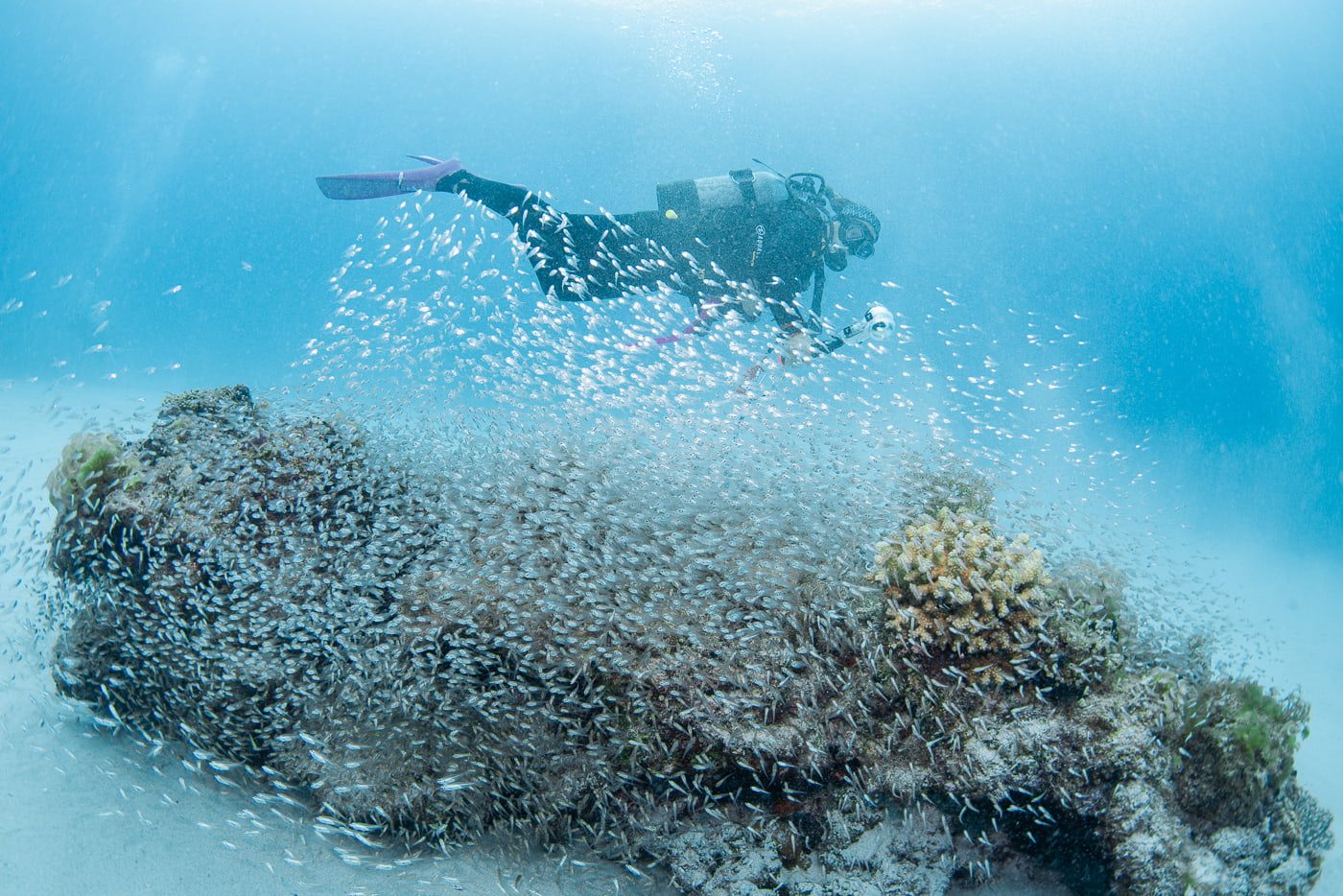
The Kerama Islands lie thirty-five kilometers west of Okinawa's main island, and beneath the surface, the archipelago's submerged topography creates a mosaic of drop-offs, caves, and coral gardens that rank among the Pacific's most concentrated dive ecosystems. The Japanese government designated the zone a national park in 2014, specifically to protect the coral reefs that had already made Kerama Blue a shorthand among divers for the water's signature cobalt transparency. The fifty-plus named dive sites distribute across the island group, but most operators concentrate on a dozen core locations accessible from Zamami and Tokashiki villages. The Unten Site off Zamami's northwest coast drops from five meters to thirty along a terrace carpeted in table corals, where green sea turtles forage on algae throughout the year. The Kannongawa Site on Tokashiki's southern flank presents a swim-through canyon system sculpted into limestone, its walls colonized by soft corals and visited by schools of bigeye trevally during summer months. Advanced divers target the Shimojishima Drop-Off, where the reef edge plunges past sixty meters and pelagic species—gray reef sharks, barracuda, occasional whale sharks—patrol the thermocline. Seasonal variation shapes both marine behavior and dive conditions. April through June delivers the clearest water and the last of the humpback whale migration, when mothers and calves rest in the shallows between Zamami and Aka Island. July and August bring the warmest water and the highest density of manta rays at cleaning stations near Kuba Island. September through November extends the calm-water window but introduces the risk of tropical storms, which can suspend boat operations for days. Winter diving from December through March remains possible, though sea temperatures drop to twenty-one degrees and visibility reduces slightly as plankton blooms increase. Marine encounters in Kerama Islands National Park diving are dictated by the reef's protected status and the archipelago's position along migratory corridors. The park's waters host five species of sea turtles, with green and hawksbill turtles present year-round at shallow foraging sites. The coral species count exceeds two hundred and fifty, dominated by Acropora staghorn formations and massive Porites colonies that survived the 1998 bleaching event. Night dives reveal bioluminescent plankton and hunting moray eels, while winter months occasionally bring pods of spinner dolphins into the bays. Operators run half-day and full-day charters from both main villages, with most itineraries covering two to three sites per trip. Certification requirements vary by site depth, and several operators offer guided snorkeling for non-divers at the turtle-frequented shallows. The national park imposes no entry fee for the marine zone, though all dive charters include environmental briefings and adhere to no-touch protocols for coral and marine life.
“The fifty-plus named dive sites distribute across the island group, creating a mosaic of drop-offs, caves, and coral gardens that rank among the Pacific's most concentrated dive ecosystems.”
The optimal period for diving in the Kerama Islands is from April to October, when water temperatures range from 22°C to 29°C and visibility is highest. To ensure safe boat departures and maximize daylight for underwater activities, visitors must adhere to the arrival window of 07:30–15:30.
22°C–26°C; mild winds. Ideal for spotting sea turtles and early-season coral activity.
26°C–29°C; calm seas. Provides the clearest water for extended diving sessions.
23°C–27°C; cooling air. Water remains warm with lower visitor numbers during this period.
—; optimal daylight. Arriving between 07:30 and 08:30 ensures priority boat scheduling.
Verdict: For the best diving conditions, aim for weekday mornings between April and October, ensuring arrival within the 07:30–15:30 window.
Kerama Islands National Park is located southwest of Okinawa Main Island, accessible primarily via high-speed boat or ferry services departing from Naha's Tomari Port (Tomarin). Travelers typically transit to Zamami Island or Tokashiki Island to reach local diving operators.
High-speed ferry from Tomari Port to Zamami Port
Ferry from Tomari Port to Zamami Port
High-speed ferry from Tomari Port to Tokashiki Port
Ferry from Tomari Port to Tokashiki Port
Plan your arrival to Tomari Port within the best arrival window of 07:30–15:30 to align with standard dive boat departures and ensure sufficient daylight for operations.
Access to Keramashoto National Park is completely free of charge, with no admission tickets required to enter the land or marine zones. Visitors only pay a small environmental tax when arriving via ferry, while diving services are operated by private businesses.
Verdict: A typical adult pays 0 JPY for park entry, with the total cost determined by your chosen private diving package and a 100 JPY local environmental tax.
Kerama Islands National Park remains open 24 hours a day, though practical diving activities are restricted to daylight hours. Individual dive shops and charter boats set their own specific daily timetables.
The park boundaries remain open year-round, though winter weather conditions can cause temporary boat cancellations.
Prepare documentation, insurance, and physical readiness before heading out to dive the Kerama reefs.
Kerama Islands National Park enforces strict marine protection regulations to preserve coral reefs and marine biodiversity. All divers must follow non-contact protocols and waste-free practices within designated conservation zones.
Everything you need to know about kerama islands national park diving
Most local dive operators welcome both beginner and advanced divers, though an Open Water certification is typically standard for full boat dives. Certain deeper sites with stronger currents require an Advanced Open Water license. Always check with your chosen dive center regarding specific depth limits and experience requirements.
The official entrance fee is 0 JPY (Free entry to the national park area). Keep in mind that while park entry itself costs nothing, you will still need to pay for boat charters, equipment rentals, and guide services. Full pricing details for activities can be found in our dedicated cost section.
Water clarity is exceptionally high, regularly exceeding 30 meters. This excellent visibility allows divers to easily observe the local coral reefs and schooling fish. The clarity remains high throughout the year, though summer offers the warmest water conditions.
Divers frequently encounter diverse species, including green sea turtles and hawksbill turtles resting along the reef slopes. The area is also home to over 200 coral species, reef sharks, and macro life like nudibranchs. In the winter months, migratory humpback whales pass through the surrounding waters.
Day trips generally coordinate with morning ferry departures from Tomari Port in Naha to ensure you reach the islands in time. Boat operators schedule their excursions to align with these arrival windows. For detailed transport options and routes, please refer to our dedicated getting there guide.
Most professional dive shops on the main islands of Zamami and Tokashiki offer full equipment rental packages, including a regulator, BCD, and appropriate wetsuit. It is advisable to reserve your gear size in advance when booking your excursion. Snorkeling equipment is also widely available for non-divers.
The best arrival window is 07:30–15:30 — Optimal window for boat departures and daylight visibility for diving. Arriving during this period ensures you can connect smoothly with morning dive departures. For further details on season timing and crowds, please refer to our dedicated guide.
The national park area itself is open 24 hours a day, 7 days a week. Specifically, the schedule runs monday: 00:00–23:59, tuesday: 00:00–23:59, wednesday: 00:00–23:59, thursday: 00:00–23:59, friday: 00:00–23:59, saturday: 00:00–23:59, and sunday: 00:00–23:59. Individual dive shops and visitor centers maintain their own specific business hours.
Kerama Island Dive Shops
Read more GuideHow to Get to Kerama Islands
Read more Tickets & toursKerama Islands Diving Tours
Read more GuideKerama Island Diving Experience
Read more Tickets & toursKerama Islands Diving from Naha
Read more GuideKerama Islands Dive Sites Guide
Read more